
Council on Criminal Justice Releases New Data, Points to Community Violence Intervention as Top Driver of National Homicide Decline
October 27, 2026
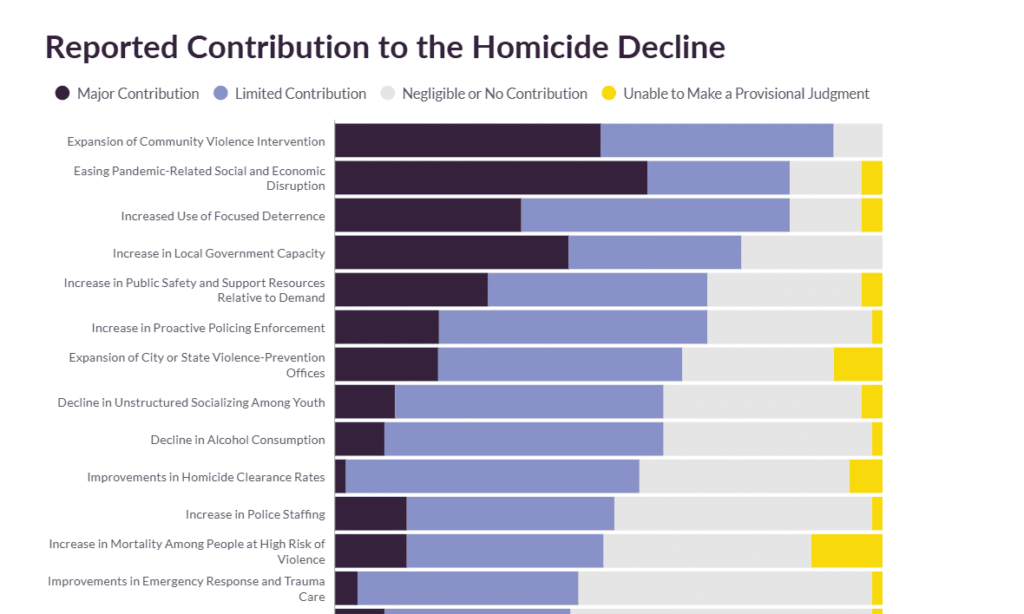
Leading crime scholars have identified Community Violence Intervention (CVI) as a top driver for a national decline in homicide over the last four years, according to a recent report published by the Council on Criminal Justice (CCJ). Informed by four dozen researchers from criminology, public health, economics, and other disciplines, the new report titled, “What’s Driving the Decline in Homicide?” assessed nearly 50 factors potentially influencing this historic reduction in violence.
While no single factor was determined as the sole explanation for this historic national decline in homicide, expanded CVI programs (community-based efforts to engage directly with people at highest risk for violence) were rated as major or limited contributors by 91% of researchers. Sixty-four percent of the researchers surveyed identified CVI as the top contributor.
Other high-ranking factors included the decline in pandemic-related disruptions, increased use of targeted law enforcement and social support toward high-risk individuals and groups, increased public safety through local government and other means, and proactive policing efforts.
These findings from CCJ come shortly after a recent report from the Center for Neighborhood Engaged Research and Science (CORNERS) at Northwestern University, which reported a 33% decrease in shooting victimizations in Chicago’s hotspot neighborhoods supported by the Peacekeepers program from July 2025 to June 2026.
The CORNERS report also notes a consistent decrease in shooting victimizations across Chicago’s highest-risk neighborhoods since fiscal year 2021. During this period, fiscal year 2026 saw the lowest cumulative number of shooting victimizations.
To accompany the new CCJ report, the council hosted a panel discussion with several of the participating researchers to more deeply explore these findings. Researchers on the panel included Andrew Papachristos, founder and faculty director of CORNERS at Northwestern University; John Roman, Senior Fellow and Director of the Center on Public Safety and Justice at the University of Chicago; Thaddeus Johnson, Senior Fellow at the Council on Criminal Justice; Stephanie Kennedy, Policy Director at the Council on Criminal Justice; and Charles Lehman, Senior Fellow at the Manhattan Institute. The discussion was moderated by Abby Walsh, Vice President of Strategy & Operations at the Council on Criminal Justice.
The aim of this convening and the resulting report was not to determine definitive causes of the national decline but provide plausible explanations across relevant disciplines and from reputable experts in the field. In terms of CVI, it seems that robust funding, professionalization, and community-centered strategies moved the needle to create a sizable impact on levels of violence across several major cities.
Papachristos described some of the developments in the CVI field that may have contributed to its efficacy in driving homicide down on a national scale.
“This field expanded tremendously,” he said. “Most importantly, [CVI] was focused on the population that was most likely to be shot at, or to pick up a gun and shoot somebody. And that is really key: violence and homicide concentrate in spaces, not just in cities or neighborhoods, but on blocks and corners in small social networks.”
Papachristos continued, “There was also innovation in using the traditional street outreach models, which put what we call ‘credible messengers’ in these networks to stop retaliation. You saw the field professionalized, you saw never [before] seen investments from the city, state, and eventually the federal government.”
Papachristos also noted that CVI efforts are not widespread throughout the nation; rather, CVI is most concentrated and supported in larger cities like Baltimore and Chicago, which drove nearly 20% of the declines in homicide. Further stabilization and expansion of funding for programs through initiatives like the Scaling Community Violence Intervention for a Safer Chicago (SC2) or the Partnership for Safe and Peaceful Communities (PSPC) could very well continue to contribute to this nationwide decrease in homicide and other violent crimes.
What’s clear is there is no single strategy for increasing public safety in our neighborhoods, cities, and across the nation. Widespread coordination between CVI programs, policing, social services, youth engagement, economic opportunities, criminal justice reform, and more is required to continue driving declines in homicide and save thousands of lives. In Chicago’s CVI field, the commitment to relentless engagement with community members at highest risk of being impacted by violence remains.
Find the report here. Watch a recording of the webinar here.